– H2GeoStore –
Maximising energy efficiency and using renewable energy sources, for the generation of electricity with a view to the full decarbonisation of Europe’s energy supply, are two of several strategic actions outlined by the European Commission to mitigate greenhouse gases by 2050. With the increasing development of renewable energy technologies (e.g. wind and solar energy), it is essential that the use of these energy resources progressively increases for a greater contribution to the overall decarbonisation of economies that mostly rely on fossil fuels.
Efforts at different dimensions – both at the international level, through the European Commission and the International Energy Agency, and at the national level, through the Portuguese Strategy for Hydrogen – highlight the importance of hydrogen as an enabler of a clean, safe, and affordable energy future. The creation of economies based on hydrogen can have relevant impacts in the future due to its versatility and importance for various sectors such as energy storage, mobility, industry, and heating supply.
Underground geological formations, namely the porous media, emerge as potential solutions due to its high storage capacity, and subsequent use, and the safety of the storage itself, since it would be carried out in the subsurface at great depths. The feasibility of these geological options is proven worldwide for the storage of other gases (e.g. natural gas), presenting advantageous petrophysical properties and storage capacities for these purposes.
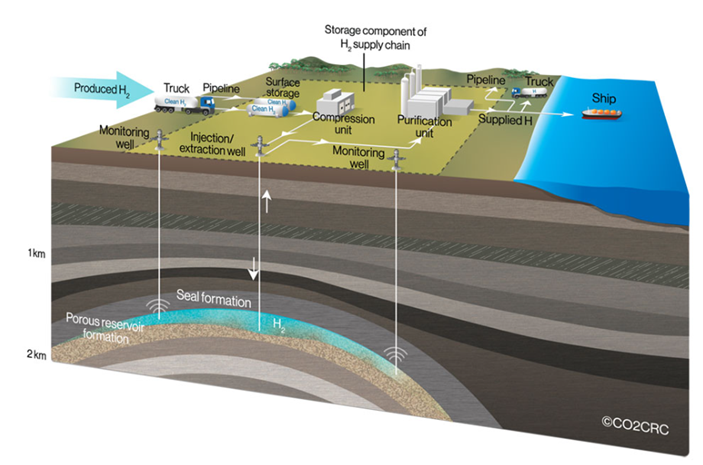
The main challenges, however, point to the lack of experience in hydrogen storage, as there are no projects currently in operation yet. Due to the specific physical properties of this gas, a full understanding of its behaviour in porous media rocks and, mainly, the interactions with potential aquifer reservoir sealing rocks are still significantly scarce in the literature to prove the feasibility of hydrogen storage in these geological formations.
The H2GeoStore project – “Hydrogen geological storage and interactions in porous media of subsurface geology” – has as main objective to study the impacts on efficiency and safety associated with cyclic processes of injection and production of hydrogen for its temporary storage in the subsurface porous media. The research and development studies proposed for this project are essentially based on the contribution to the state of the art and maturation of the feasibility of hydrogen storage in porous media, particularly in saline aquifers.
 |
||||
– About the Project –
WHAT
The project H2GeoStore – “Hydrogen geological storage and interactions in porous media of subsurface geology” aims to study of the feasibility of porous sedimentary rocks, in terms of efficiency and safety, for the geological storage of hydrogen. Several Geoscience multidisciplinary studies are planned, largely involving numerical modelling to evaluate the hydrodynamic, mechanical, chemical, and hydraulic processes at the performance level of these geological options for hydrogen storage, as well as for studies of potential impacts of temporary and long-term storage on the integrity of the storage complexes.
WHY
Recognising the game change potential of hydrogen in the energy system and decarbonisation, the European Commission established a hydrogen strategy for a climate-neutral Europe, developing a roadmap to 2050 of a hydrogen ecosystem. The International Energy Agency also states that hydrogen is firmly on the path to becoming a significant enabler of a clean, safe, and affordable energy future.
This reinforces the requirement of geological storage options with high storage capacity and capable of providing temporary (monthly to seasonal) storage. Storing large volumes of such a low-density gas (i.e., hydrogen requires much larger storage capacities comparing to other gases) can only be achieved resorting to storage in geological formations.
Many countries have experience in storing natural gas in caverns built in salt domes, but the capacity of each cavern is limited, and the building of these artificial cavities may also pose environmental issues for the final disposal of the highly saline solution due to the partial dissolution of these salt formations. That may not be feasible economically, or even technically, given the geological conditions of several countries, due to the specific geographical distribution of these subsurface storage options.
HOW
Alternative geological reservoirs will need to be considered, namely sedimentary porous rocks (i.e., depleted hydrocarbon filed and saline aquifers) with a very large potential volume that can be used for hydrogen storage, besides the fact they exist at a large-scale worldwide. Nonetheless, huge efforts of R&D are currently required to confirm the efficient implementation of these technologies in practice, namely feasibility projects in terms of safety and efficiency of hydrogen storage in saline aquifers.
H2GeoStore project will develop efforts to clarify the behaviour of hydrogen in porous media, particularly the saline aquifer option. Advanced computational studies will be conducted to clarify the geological and engineering constraints, imposed by the specific properties of hydrogen to its storage in heterogeneous porous media, proposing a consistent methodology and optimised strategies of hydrogen injection and withdrawal processes to maximise the potential of these storage options, which can be comparable and/or replicated by the international scientific community for screening future storage sites worldwide.
WHO
A team with a solid multidisciplinary background, covering several Geoscience areas such as energy, subsurface characterisation and modelling, geochemistry, geology, hydrogeology, reservoir engineering and geomechanics.
Objectives
H2GeoStore project aims to study the safety and efficiency impacts associated with the hydrogen injection and withdrawal cyclic processes for the temporary storage in subsurface porous media.
The R&D studies proposed in H2GeoStore are essentially based on the contribution to the state-of-the-art and maturation of hydrogen storage feasibility in porous media, particularly in saline aquifers. The fully understanding of the various dynamic processes of reservoirs and mainly the interactions with caprocks are still scarce in this literature field. The main challenges relate to the scarce knowledge about the behaviour of hydrogen in porous media rocks. Hydrogen is the smallest molecule, with a high diffusivity, which poses challenges to the type of caprock that can trap it in the reservoir. H2GeoStore specific objectives aim at addressing some of those challenges.
Approach
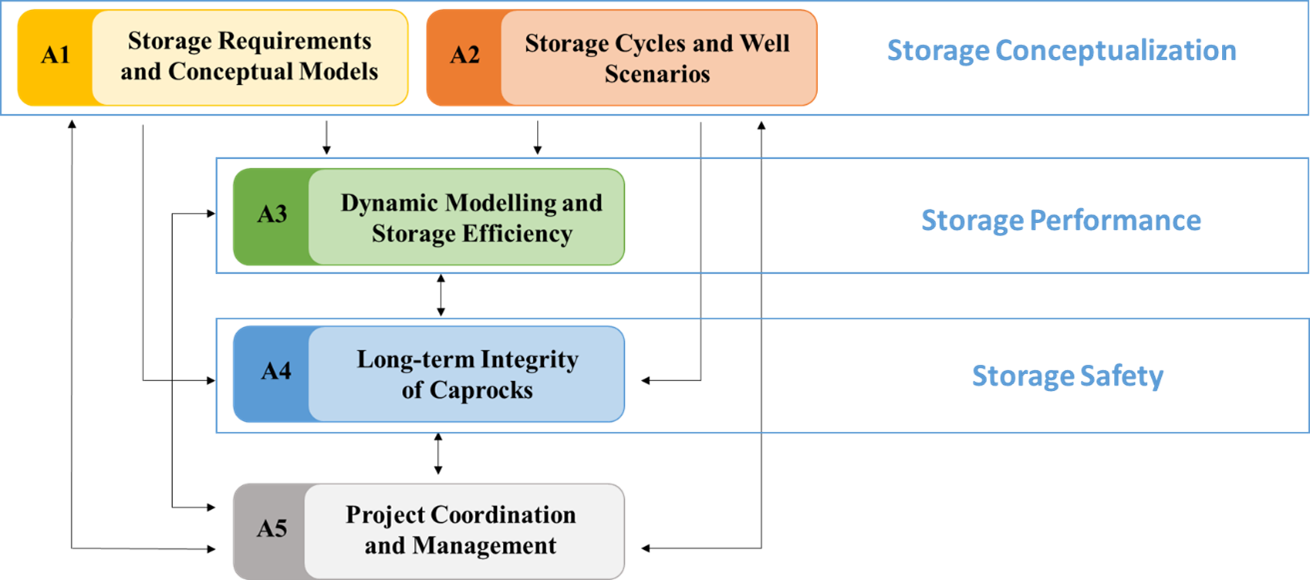
The execution of this project is essentially based on three main pillars:
- Storage conceptualization: implementation of the framework and requirements for hydrogen storage in saline aquifers as well as the definition of realistic operational scenarios;
- Storage performance: dynamic modelling of space-time reservoir interactions for the evaluation of the inherent processes and efficiency of hydrogen storage; and
- Storage safety: characterisation and modelling of the long-term impacts of hydrogen in the integrity of the sealing rock geology.
Flowchart of the activities of the project
Impacts
- Societal and Environmental


ODS 7 and 13
Urgent actions to combat climate change and to provide sustainable energy lie at the heart of both the 2030 Agenda for Sustainable Development and the Paris Agreement on Climate Change. The challenge of achieving these goals, in a context of world population growth and increasing energy demand, requires a progressive shift from a fossil fuel-based energy system to renewable energy sources (RES).
To effectively contribute to climate change mitigation, replacing fossil fuels, the European Hydrogen Strategy takes a front role in achieving these ambitions, highlighting the importance of green hydrogen production, generated by electrolysis of water powered by RES (i.e., with zero GHG emissions), in a massive scale over the next decades. Acting as an outstanding energy carrier, hydrogen can solve the limitations of intermittency and non-dispatchability of RES in the energy system, providing the large-scale energy storage solution. The scales required for the seasonal energy storage (TWh-scale) can only be reached by geological storage in porous media, contrarily to the existing solutions such as the surface tanks (KWh-scale) and salt caverns (GWh-scale).
Besides the relevance of hydrogen for the energy system, the reinforcement of its potential economic and societal benefits has been extended to the mobility, heating and industry sectors towards a climate-neutral Europe and hydrogen-based sustainable economies, which will require safe solutions and large storage capacities for these purposes.
Due to the relevance of this topic in an international standpoint, H2GeoStore will contribute to the SDGs 7 and 13 in studying the viability of the porous sedimentary rocks for hydrogen storage, in terms of storage integrity and performance, and understanding the complex behaviour and interactions of hydrogen in these geological environments, particularly for saline aquifers, whose literature is still quite scarce and the answers for several scientific challenges remain.
- Scientific and Technological
Findings of this project will advance the state-of-the-art of potential long-term impacts associated with the hydrogen retention capacity and the integrity of different caprocks due to the cyclical operations for the temporary storage. The successful completion of H2GeoStore may have a valuable impact to increase the insights and maturity of hydrogen storage in porous media – seen as promising geological storage solutions with worldwide geographical distribution and at a much lower economic and environmental costs than the existing salt caverns.
H2GeoStore also aims to address some of the barriers and challenges that may be faced by the industrial efforts to implement the technology, which is of utmost importance, not only for Portugal but on the international level, to achieve the ambitious decarbonising goals.
Expected Outcomes
The project outcomes include:
- appropriate geological and technical condition requirements for storing hydrogen in porous media;
- broader contribution of the dynamic behaviours of multiphase flow processes and interactions in porous media over time;
- space-time characterisation of induced (i.e. hydraulic and thermal) effects within reservoirs;
- optimised strategies of operating conditions and storage cycles to maximise the amounts of recoverable hydrogen under the proposed realistic models;
- considerations about the integrity of caprocks and suitable rock types and properties to retain hydrogen in saline aquifers.
 |
||||
– News & Events –
WEBINARS
H2GeoStore: Webinar 1 – “Energy Geological Storage”
Series of Webinars in Advances in Geo-energy
Wednesday, December 6th 2023, 11:00
- “Overview of the H2GeoStore project”
Dr. Pedro Pereira, Universidade de Évora
- “Perspective on energy storage needs in Portugal”
Professor Paulo Canhoto, Universidade de Évora
- “Geological energy storage: viable reservoirs and technologies”
Dr. Catarina Matos, CIIAE – Centro Ibérico de Investigación en Almacenamiento Energético
- “Characterization of the geological energy storage potential in Europe – ESTMAP and HySTORIES projects”
Professor Júlio Carneiro, Universidade de Évora
- “Discussion and Q&A”
All Speakers and Audience
H2GeoStore: Webinar 2 – “Hydrogen Geological storage”
Wednesday, November 27th 2024, 14:00
- “Overview of the H2GeoStore Project”
Dr. Pedro Pereira, Universidade de Évora
- “Evaluation of Large-scale Energy Storage Potential in Morocco”
Dr. Nour Eddine Berkat, ONHYM
- “New alternatives for the use of geological reservoirs: Recôncavo Basin case study”
Professor George Câmara, SENAI Cimatec University
- “Theoretical Potential for Hydrogen Storage in a Saline Structure in Bahia, Brazil”
Professor Roberto Câmara, Federal University of Recôncavo of Bahia
- “Q&A and Discussion Session”
All Speakers and Audience
H2GeoStore: Webinar 3 – “Hydrogen geological storage and interactions in porous media of subsurface geology”
Thursday, February 27th 2025, 15:00
- “H2GeoStore Project Outcomes”
Dr. Pedro Pereira, Universidade de Évora
- “Q&A and Discussion Session”
Speaker and Audience
National / International Conferences
– X Jornadas da Associação Portuguesa de Geólogos (APG 2023, November 8-11):
- Oral Presentation: “Hydrogen geological storage: opportunities, challenges and interactions in porous media”.
– 17th CO2GeoNet Open Forum (CO2GeoNet 2024, May 21-22):
- Poster Presentation: “Efficiency assessment and dynamic interactions in hydrogen geological storage in saline aquifers”.
– 19th Conference on Sustainable Development of Energy, Water and Environment System (SDEWES 2024, September 8-12):
- Oral Presentation: “Interactions and impacts on the efficiency of underground hydrogen storage in saline aquifers”.
– 5th European Association of Geoscientists and Engineers Global Energy Transition Conference & Exhibition (EAGE GET 2024, November 5-7):
- Oral Presentation: “Hydrogen storage in heterogeneous reservoir: evaluating well configurations and cushion gas impact”.
– Publications –
Scientific Publications
– International Journal of Hydrogen Energy:
Pereira, P., Canhoto, P., Khudhur, K., Carneiro, J., Pedro, J. and Mazezo, A. (2025). Hydrogen geological storage in saline aquifers based on seasonal and hourly cyclic profiles and the effects of integrating cushion gas. International Journal of Hydrogen Energy, Volume 157, 150111. https://doi.org/10.1016/j.ijhydene.2025.150111.
– European Association of Geoscientists and Engineers:
Pereira, P., Carneiro, J., Canhoto, P., Pedro, J., Khudhur, K. and Mazezo, A. (2024). Hydrogen Storage in Heterogeneous Reservoirs: Evaluating Well Configurations and Cushion Gas Impact. European Association of Geoscientists and Engineers, Fifth EAGE Global Energy Transition Conference & Exhibition (GET 2024), Nov 2024, Volume 2024, p.1 – 5. https://doi.org/10.3997/2214-4609.202421195.
|
||||
– Contacts –

 |
 |
 |